
Introduction
Rick Owens is an American-born, Paris-based fashion designer who has spent over three decades building one of the most distinctive and commercially successful independent luxury brands in the world. As of February 2026, Owens remains one of the few high-fashion designers to maintain 100 percent independence and ownership of his organisation, with annual revenues estimated to exceed €150 million.
That combination — genuine avant-garde credibility paired with nine-figure revenue — is almost unheard of in contemporary fashion. Most designers of his stature eventually sell to LVMH, Kering, or another conglomerate. Owens has not. Instead, he has built a self-contained universe through Owenscorp, his privately held company, spanning ready-to-wear, footwear, furniture, and a long list of high-profile collaborations. His influence extends from Paris Fashion Week runways to hip-hop lyrics, from museum retrospectives to the feet of musicians and athletes worldwide.
This guide covers Rick Owens’ background, his unmistakable aesthetic, his business model, his most important collections and collaborations, and what makes his work endure.
Quick Facts
| Detail | Information |
|---|---|
| Full Name | Richard Saturnino Owens |
| Born | November 18, 1961, Encino, California |
| Raised | Porterville, California |
| Based | Paris, France |
| Label Founded | 1994 |
| Company | Owenscorp (100% independent) |
| Annual Revenue | Estimated €150+ million |
| Estimated Net Worth | $200 million |
| Spouse / Partner | Michèle Lamy |
| Signature Lines | Rick Owens, DRKSHDW, Rickowenslilies, Hunrickowens |
| Notable Awards | CFDA Perry Ellis Award (2002), CFDA Lifetime Achievement (2017), FGI Superstar Award (2024) |
Who Is Rick Owens?
Early Life and Formation
Richard Saturnino Owens was born on November 18, 1961, in Encino, California, and raised in Porterville, a conservative agricultural community in California’s Central Valley. His mother, Concepción, is of Mexican heritage, and he grew up in a strict Catholic household. His upbringing — deprived of television but surrounded by his father’s library — shaped an early fascination with France and classical aesthetics.
After high school, Owens moved to Los Angeles and enrolled at the Otis College of Art and Design, initially intending to become a fine artist. He left after roughly two years and shifted toward the practical craft of clothing construction, studying patternmaking and draping at Los Angeles Trade-Technical College. That technical education became the foundation of his career. Rather than entering fashion through celebrity connections or a prestigious European house, Owens spent years working as a pattern cutter and in Los Angeles garment businesses, learning how clothing was physically constructed.
Expert insight: Owens’ background as a pattern cutter rather than a fine-arts graduate gave him a structural understanding of garments that continues to define his work. His clothes are not draped conceptually — they are engineered. This technical fluency is why his exaggerated proportions hold their shape on the body rather than collapsing into costume.
The Michèle Lamy Partnership
Owens met Michèle Lamy in Los Angeles in the late 1980s when she hired him to work on her clothing line. Lamy — a French culture and fashion figure, former lawyer, and creative force in her own right — became his business partner, muse, and eventual wife. They married in 2006. Their partnership is one of the most enduring and creatively productive in contemporary fashion. Lamy has curated exhibitions of Owens’ furniture, appeared in campaigns, and remains co-owner of Owenscorp.
The Rick Owens Aesthetic: Why It’s Instantly Recognisable
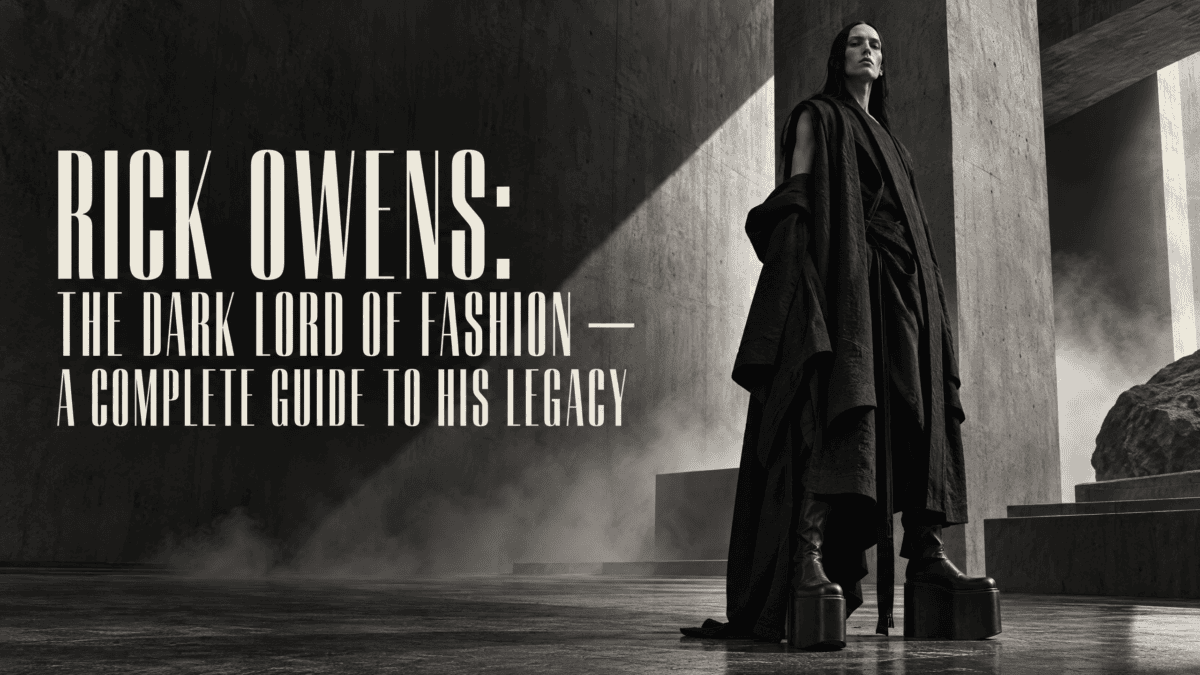
The Rick Owens look is not subtle. It is a collision of glamour and grunge, where platform boots are paired with flowing gowns, cocoon-like jackets top drop-crotch sweatpants, and skin-tight leather is tucked into high-top sneakers. His garments are defined by exaggerated proportions, elongated silhouettes, asymmetrical cuts, and a colour palette that almost always returns to black, grey — the shade he calls “dust” — and muted earth tones.
Owens’ aesthetic draws from a specific set of references: Brutalist architecture, Brancusi’s sculpture, Iggy Pop, Oscar Wilde, and the disciplined severity of his Catholic upbringing. The result is clothing that feels simultaneously ancient and futuristic — what one critic described as “terraformers on distant planets or road warriors in the Mad Max movies of old”.
His accessories — particularly the Geobasket sneakers, Ramones sneakers, and platform boots — have become cult objects, worn by musicians, athletes, and fashion collectors alike. A$AP Rocky famously rapped “Rick Owens usually what I’m dressed in” in his 2011 hit “Peso,” cementing the brand’s crossover into hip-hop culture.
The Owens Silhouette in Practice
| Element | Signature Characteristics |
|---|---|
| Outerwear | Cocoon-like jackets, cropped leather blousons, oversized wool coats |
| Tops | Elongated tees, asymmetrical draping, drop-shoulder construction |
| Trousers | Drop-crotch sweatpants, wide-leg technical trousers, denim cut-offs |
| Footwear | Platform boots, Geobaskets, Ramones, chunky quad-sole boots |
| Materials | Washed leather, heavy denim, technical nylon, silk, latex |
| Palette | Black, grey (“dust”), muted earth tones, occasional mineral pastels |
Career Timeline: From Hollywood Boulevard to the Palais Galliera
| Year | Milestone |
|---|---|
| 1961 | Born in Encino, California; raised in Porterville |
| Early 1980s | Studies art at Otis; drops out; trains as a pattern cutter at LA Trade-Technical College |
| Late 1980s | Hired by Michèle Lamy; begins pattern-cutting work |
| 1994 | Launches eponymous label, selling exclusively to Charles Gallay in LA |
| 2001 | Agrees distribution deal with Eo Bocci Associati; production moves to Italy |
| 2002 | Debuts first runway show at New York Fashion Week, sponsored by American Vogue; wins CFDA Perry Ellis Award |
| 2003 | Moves to Paris; begins showing at Paris Fashion Week |
| 2004 | Founds Owenscorp in France; label becomes fully independent |
| 2002–2007 | Artistic director at Revillon (French fur house) |
| 2007 | Shows first furniture collection in Paris |
| 2017 | Receives CFDA Lifetime Achievement Award; publishes Rick Owens Furniture |
| 2019 | Publishes Legaspi: Larry Legaspi, the 70s, and the Future of Fashion |
| 2024 | Receives FGI Superstar Award marking 30th anniversary |
| 2025 | Opens Seoul flagship; Temple of Love retrospective at Palais Galliera |
| 2025 | Bans fur from all future collections following CAFT campaign |
| 2026 | Shows Fall 2026 “Tower” collection; SS27 “Stone” collection with adidas; Dr. Martens Quad Sole collaboration |
Breakthrough and Rise: How Rick Owens Became a Global Force
The Kate Moss Moment
Owens’ international breakthrough came when French Vogue ran an image of Kate Moss wearing one of his signature leather jackets. With support from Anna Wintour, American Vogue sponsored his debut show at New York Fashion Week for the Spring/Summer 2002 season. That moment transformed Owens from an underground LA designer into a name on the international fashion calendar.
The Move to Paris
In 2003, Owens relocated to Paris, where he began showing during the Paris collections. He is one of the few American designers to consistently show his own label at Paris Fashion Week for more than two decades. The city gave him not just a platform but a philosophical home — its Brutalist architecture, its intellectual culture, and its embrace of artistic provocation aligned with his sensibilities.
Beyond Clothing
Owens has consistently expanded beyond fashion. He designs furniture — first shown in Paris in 2007 — using bronze, resin, marble, antler, and stone. His furniture work is displayed in galleries worldwide, including a dedicated gallery in Paris opened in 2025. He has authored multiple books, including Rick Owens Furniture (2017) and Legaspi (2019). In 2025, his first major Paris retrospective, Temple of Love, opened at the Palais Galliera, spanning over 100 silhouettes from his archive and running through January 4, 2026.
The Business of Rick Owens: Independence as Strategy
Owenscorp: A Privately Held Empire
Owenscorp, the company behind the Rick Owens brand, is almost entirely owned by Owens and his partner Michèle Lamy. Unlike many prominent designers whose namesake labels were eventually acquired by conglomerates such as LVMH or Kering, Owens has retained a majority ownership stake and has deliberately resisted selling control.
The company generates annual revenues estimated to exceed €150 million as of February 2026. By the middle of the 2010s, it was already generating approximately $120 million annually; later reports placed turnover at roughly €120 million, with the business remaining firmly in nine-figure territory. Celebrity Net Worth estimates Owens’ personal net worth at $200 million.
Revenue Streams
| Category | Details |
|---|---|
| Main Line | Rick Owens ready-to-wear (men’s and women’s) |
| Diffusion | DRKSHDW, Rickowenslilies, Hunrickowens |
| Footwear | Main line plus collaborations (adidas, Dr. Martens, Converse) |
| Furniture | Rick Owens Furniture line, gallery representation |
| Collaborations | adidas, Moncler, Rimowa, Selahatin, Birkenstock, Dr. Martens |
| Retail | Flagship stores including Seoul (2025), Paris, New York |
Recent Collections: Fall 2026 and Spring/Summer 2027
Fall 2026: “Tower” — Warrior Women and Mineral Hues
Owens’ Fall/Winter 2026 womenswear collection, titled “Tower,” was presented at the Palais de Tokyo in March 2026. The collection was inspired by “Temple of Love, Tower of Light,” described in the designer’s show notes as a prayer for love and hope. The show featured striking hair and beauty looks developed in collaboration with Berlin-based artist Figa Link.
Critics noted that Owens swapped his habitual jet-black leather and latex for mineral hues — stone-inspired tones that produced a collection of “ferocious glamour”. Key pieces included mammoth outerwear, strapless technical dresses, long leather or wool vests, cropped jackets, denim cut-offs, and heavy boots.
Spring/Summer 2027: “Stone” — Sportswear Meets Sci-Fi
Owens’ SS27 menswear show, held in June 2026 during Paris Fashion Week, marked his first partnership with adidas since 2017. The collection, titled “Stone,” featured inflatable jackets with built-in cooling systems, long draped coats, and air-filled tracksuits. Owens took over the reflecting pool at the Palais de Tokyo, creating an atmosphere that felt serene — almost devotional — with models walking on a sloping runway built over steel grating.
A high-performance adidas x Rick Owens running shoe, engineered to be affordable, is slated for 2027 release.
Collaborations: From Sportswear to Oral Care
Rick Owens has built a portfolio of collaborations that range from the expected to the genuinely unexpected. Each partnership carries his aesthetic signature, whether applied to footwear, outerwear, luggage, or — in one notable case — toothpaste.
Key Collaborations
| Partner | Collection / Product | Year |
|---|---|---|
| adidas | SS27 “Stone” collection; ClimaCool inflated apparel; running shoe (2027) | 2026–2027 |
| Dr. Martens | Quad Sole Collection (Pull-On Boot, Megalace Mule, Steel Toe Boot) | 2026 |
| Moncler | Brutalist architecture-inspired collection | 2026 |
| Selahatin | Oral care ritual: toothpaste, mouthwash, horn toothbrush | 2025 |
| Converse | Reimagined Chuck 70 in high and low-top variants | Ongoing |
| Rimowa | Luggage collaboration | Recent |
| Birkenstock | Footwear collaboration with accompanying zine | 2018 |
The Selahatin collaboration is perhaps the most illustrative of Owens’ approach. The four-piece collection — whitening toothpaste, mouthwash, an eau d’extrait oral, and a handmade horn toothbrush — recasts hygiene as ceremony. The toothbrush features a handcrafted handle in natural horn with authentic boar bristles, positioning oral care as a ritual of poise rather than mere maintenance.
Expert insight: Owens’ collaborations work because they are not marketing exercises. Each partnership extends his philosophy — the elevation of the essential, the ritualisation of the everyday — into a new category. The Selahatin collection, for instance, is not about toothpaste. It is about the idea that even brushing your teeth can be an act of aesthetic discipline.
Controversies and Ethical Shifts
The Fur Ban
In December 2025, Rick Owens confirmed that his brand would cease using animal fur in all future collections. The decision followed a five-day protest campaign by the Coalition to Abolish the Fur Trade (CAFT), during which activists staged demonstrations in London, Los Angeles, and New York City. The brand also removed mink and beaver fur handbags from its online store.
In a statement to CAFT, Owens and Owenscorp said the company had been working to reduce and eventually eliminate fur production “over the past decade,” adding: “We will not engage in fur production in the future”. The decision aligns Owens with a growing number of luxury houses and fashion institutions — including Condé Nast, New York Fashion Week, and Australian Fashion Week — that have enacted fur bans.
Provocation as Method
Owens has consistently used his runway shows as platforms for provocation. Models have walked through pink-hued smoke, waded through water, carried other models, and shaved their eyebrows at his direction. These choices are not gimmicks — they are part of Owens’ philosophy that fashion should challenge rather than comfort. As he told The New York Times: “I’m not good at subtlety. If you’re not going to be discreet and quiet, then just go all the way”.
Expert Insights: Why Rick Owens Endures
1. Technical Mastery Meets Conceptual Vision
Owens’ training as a pattern cutter is the foundation of his longevity. Unlike designers who work primarily through illustration or concept, Owens understands construction at a granular level. This allows him to push proportions to extremes — elongated sleeves, dropped shoulders, exaggerated volumes — while ensuring garments remain wearable and structurally sound. His pieces are not costumes; they are engineered objects.
2. Independence as Creative Insurance
By retaining full ownership of Owenscorp, Owens has insulated his creative decisions from shareholder pressure. He does not need to chase trends or dilute his vision to satisfy quarterly earnings. This independence is increasingly rare in luxury fashion, where conglomerates dominate, and it is arguably the single most important factor in the brand’s consistency over three decades.
3. Cultural Cross-Pollination
Owens’ influence extends far beyond the fashion press. His adoption by hip-hop artists — from A$AP Rocky to Playboi Carti and Lil Baby — has given the brand a cultural relevance that most luxury houses struggle to manufacture authentically. When a rapper name-checks your brand in a hit song, that is not marketing; that is cultural currency.
4. The Museum Validation
The Temple of Love exhibition at the Palais Galliera (June 2025 – January 2026) represents a different kind of validation. Museums do not stage retrospectives for designers who are merely commercially successful. They stage them for designers who have shaped the visual culture of their era. Owens’ inclusion in that canon is now secure.
Read More: Ludovic de Saint Sernin: The Sensual Fashion Visionary Redefining Style
Frequently Asked Questions
Who is Rick Owens?
Rick Owens is an American-born, Paris-based fashion designer known for his gothic, avant-garde aesthetic, exaggerated proportions, and signature use of black and muted earth tones. He founded his eponymous label in 1994 and has built one of the few remaining fully independent luxury fashion empires through his company, Owenscorp.
What is Rick Owens known for?
He is known for his distinctive aesthetic — dark, architectural, and sculptural — as well as his cult footwear (Geobaskets, Ramones, platform boots), his leather jackets, and his provocative runway shows. His influence spans fashion, music, and furniture design.
Is Rick Owens a luxury brand?
Yes. Rick Owens operates at the luxury level, with ready-to-wear, footwear, accessories, and furniture sold through his own boutiques and select high-end retailers worldwide. Annual revenues exceed €150 million as of 2026.
How does Rick Owens sizing run?
Rick Owens clothing uses Italian numeric sizing and is cut deliberately oversized and architectural. The house cut is long in the body and sleeve by design. Footwear generally fits true to size, though some styles — particularly Ramones and Geobaskets — run narrow. Many customers size down for a more fitted look.
Who is Rick Owens’ wife?
Rick Owens has been married to Michèle Lamy since 2006. Lamy is a French culture and fashion figure, his longtime muse, and his business partner in Owenscorp. She has curated exhibitions of his furniture and remains a central creative force in the brand.
Why did Rick Owens ban fur?
Rick Owens confirmed in December 2025 that his brand would cease using animal fur in all future collections, following a protest campaign by the Coalition to Abolish the Fur Trade. The company stated it had been working to reduce and eliminate fur production over the past decade.
Conclusion
Rick Owens has achieved something extraordinarily rare: he has built a globally recognised luxury brand without compromising his vision or surrendering control. From a raw storefront off Hollywood Boulevard to the Palais Galliera, from a single leather jacket photographed on Kate Moss to a €150 million independent empire, his trajectory is a case study in what happens when technical mastery, conceptual clarity, and business independence align.
His Fall 2026 “Tower” collection and SS27 “Stone” collaboration with adidas demonstrate that his creative output remains as vital as ever. The Temple of Love retrospective has cemented his place in fashion history. And the fur ban signals a willingness to evolve even after three decades in the industry.
For anyone studying fashion — as a designer, a consumer, or simply an observer — Rick Owens offers a lesson that extends beyond aesthetics. He proves that the most commercially successful approach is often the one that refuses to follow the market. Darkness, it turns out, sells — provided it is rendered with rigour, conviction, and an uncompromising eye for construction.